

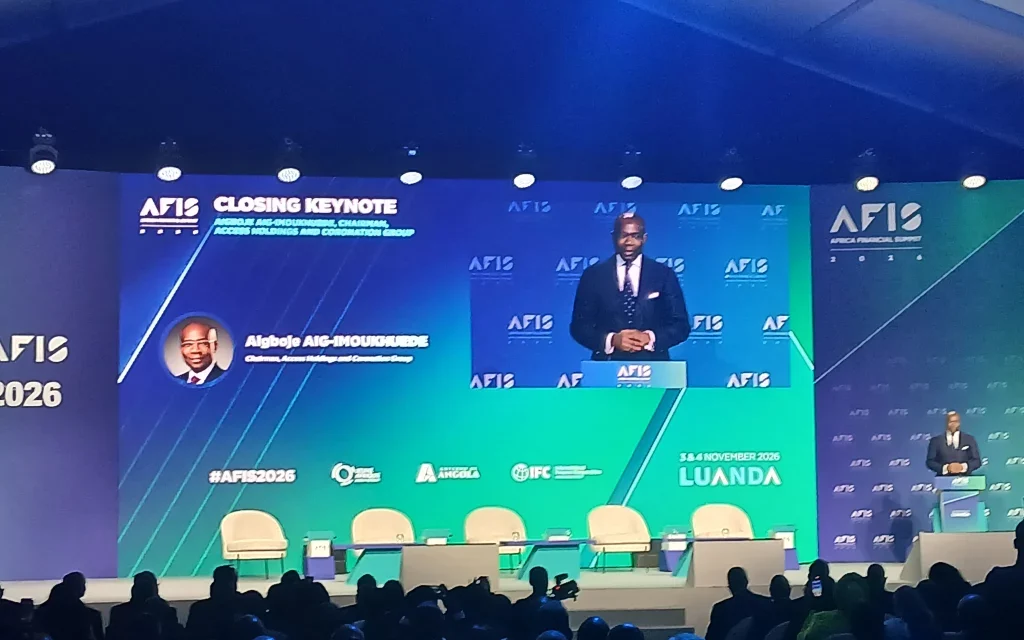
Aigboje Aig-Imoukhuede, chairman of Nigerian tier-1 lender Access Bank Group and monetary providers holding firm Coronation Group, argues that African monetary establishments must transfer past monetary stability to productive finance, unlock capital tied up in industrial transactions and construct banking techniques able to working throughout borders.
Africa’s monetary establishments have spent years debating the supply and price of capital. However, Aig-Imoukhuede believes the continent is asking the unsuitable query.
Rather than focusing totally on how a lot capital Africa can appeal to, he needs policymakers and monetary establishments to look at how successfully the cash already obtainable is being deployed.
“At this particular moment in Africa’s development, I believe the more important question is: How do we make better use of the capital we already have?” he mentioned throughout the closing session of the Africa Financial Industry Summit (AFIS) in Luanda, Angola.
His argument is that the continent’s monetary techniques must turn into higher at connecting current capital to companies, productive financial exercise and long-term investments. Without that shift, monetary stability and stronger banking establishments could not translate into the broader financial prosperity Africa wants.
Aig-Imoukhuede outlined three priorities for reaching this: unlocking capital trapped in industrial transactions, mobilising long-term financial savings for long-term investments, and addressing authorities borrowing that limits the personal sector’s entry to financing.
The cash trapped in industrial transactions
One of the largest alternatives, in his view, lies within the financing of small and medium-sized enterprises (SMEs).
Across Africa, companies generate important financial worth via manufacturing and industrial actions, usually in cycles lasting 90 to 120 days. Yet smaller companies that offer items and providers to bigger firms steadily battle to entry financing.
A provider could fulfil an order for a giant company and report a credible industrial transaction on its books, but nonetheless face liquidity constraints as a result of its personal credit score profile is weaker than the customer’s.
Aig-Imoukhuede believes monetary establishments ought to change how they assess such transactions.
“When an SME supplies goods or services to a creditworthy buyer, that transaction should enable the SME to access financing at a rate that reflects the creditworthiness of the buyer, rather than the weaker credit profile of the small supplier,” he mentioned.
In impact, the industrial transaction itself may turn into the idea for accessing credit score, permitting smaller companies to learn from the monetary energy of the bigger firms they provide.
He pointed to digital invoicing for instance of the infrastructure that might make this doable, citing greater than three billion registered invoices in India, following the introduction of digital invoicing a decade in the past, and roughly 60 billion in Brazil.
He argued that Africa may unlock important financial worth by growing related techniques, significantly given the continent’s giant inhabitants of SMEs and sole merchants.
The proposal requires central banks, industrial banks and different monetary establishments to rethink how they assess creditworthiness. Instead of relying totally on the monetary standing of particular person small companies, lenders may use verified industrial transactions and the customer’s energy to help financing.
That would tackle a persistent constraint for smaller suppliers: the hole between producing income and receiving cost.
Why long-term tasks want long-term cash
A second precedence is mobilising financial savings for investments that require longer financing phrases.
Aig-Imoukhuede argued that banks can not proceed to rely closely on deposits that prospects can withdraw at brief discover to finance tasks requiring capital over 20 years.
“We cannot continue to rely on bank deposits, which can be withdrawn tomorrow, to finance long-term projects that require 20-year money,” he mentioned.
He believes there may be an urge for food amongst Africans for longer-term financial alternatives, however the monetary channels linking their financial savings to such investments should be developed.
He cited the Dangote Refinery as proof that traders are keen to take part in main real-sector tasks and earn returns from financial exercise.
The problem, due to this fact, shouldn’t be merely encouraging individuals to save lots of, however creating funding constructions that allow their financial savings to finance productive belongings over acceptable time horizons.
This would require monetary establishments and markets to supply avenues for odd traders to take part in main tasks, relatively than leaving such alternatives to a comparatively small pool of traders.
His argument additionally raises a broader query concerning the function of African pension funds and different institutional traders. These swimming pools of capital may play a larger function in financing infrastructure and productive belongings as a substitute of remaining closely concentrated in authorities securities.

Government borrowing and the personal sector
A 3rd constraint is the extent to which authorities borrowing competes with personal companies for obtainable financing.
Aig-Imoukhuede acknowledged that governments have professional funding necessities, however warned that public borrowing can restrict the capital obtainable to companies.
He argued that central banks can not tackle this problem in isolation. Collaboration amongst financial authorities, fiscal policymakers, and the personal sector is important to attain a extra sustainable steadiness between authorities financing wants and private-sector funding.
He urged that central financial institution governors and finance ministers ought to work collectively extra intentionally on the difficulty.
The underlying concern is that a monetary system can stay secure whereas failing to supply enough financing for companies able to increasing manufacturing, creating jobs and supporting financial development.
As he put it, a banking system may be secure and worthwhile however nonetheless serve an financial system that’s basically unproductive.
African banks must compete past their house markets
Aig-Imoukhuede additionally challenged African banks to look past the rising presence of regionally owned establishments and deal with their potential to compete internationally.
The departure of a number of worldwide banks from African markets has created alternatives for home and regional monetary establishments. But he argued that African possession alone shouldn’t be handled as proof of progress.
“Is it enough that an international bank has exited Africa and an African bank has taken its place? No, it is not,” he mentioned.
The subsequent problem, he argued, is to translate the size of African banks into globally aggressive establishments able to serving prospects throughout a number of markets.
He mentioned African banks must develop stronger regional methods and cross-border operations, whereas establishing the infrastructure wanted to attach African companies and people to the worldwide monetary system.
“We must be present in the G7 countries. We must have clearing status and establish clearing infrastructure, whether digital or through other channels, that allows African businesses and citizens to remain connected to the global economy,” he mentioned.
His feedback level to a distinction between having African-owned banks working in particular person nations and constructing establishments able to supporting companies throughout borders and competing with worldwide monetary teams.
For Aig-Imoukhuede, the latter is the extra consequential ambition.
Financial integration can not occur with out the motion of individuals
The argument for stronger African banking establishments is intently linked to his broader name for continental integration.
Aig-Imoukhuede mentioned the dialogue about African integration shouldn’t be restricted to the prospect of a common forex. Before a financial union can turn into significant, nations must tackle the sensible boundaries that prohibit the motion of products, providers, capital and folks.
He illustrated the issue together with his personal expertise on the summit. His chief of employees couldn’t journey with him to Angola as a result of he was unable to acquire a visa in time.
The expertise, he mentioned, uncovered the contradiction in discussing continental integration whereas motion between African nations stays tough.
“We cannot build an integrated African banking industry or financial system without integrating the movement of goods, services and people,” he mentioned.
He argued that integration must precede financial union, requiring nations to determine the sensible situations for companies, traders and people to function throughout borders.
That consists of functioning monetary infrastructure, simpler settlement preparations and cooperation between regulators.
Without these techniques, African banks could increase into extra nations with out delivering the total advantages of an built-in market.
Making capital depend
Aig-Imoukhuede’s proposals finally return to at least one central difficulty: Africa must enhance the connection between its obtainable capital and the financial actions that want it.
He known as for a extra productive monetary system, the combination of African monetary markets, and larger macroeconomic convergence, together with improved alignment of inflation and financial stability throughout nations.
He additionally challenged the continent to rethink who advantages from financing main investments. The Dangote Refinery, in his illustration, mustn’t stay an remoted instance of large-scale capital mobilisation. More Africans ought to be capable of put money into and profit from transformative tasks.
He framed the check of progress over the following 10 to twenty years round whether or not African companies can elevate capital effectively throughout borders, whether or not pension funds could make extra significant investments in infrastructure and productive belongings, and whether or not the continent can lastly make its obtainable capital depend.
For Africa’s monetary establishments, the implication is obvious: attracting extra money won’t, by itself, resolve the continent’s financing constraints. The larger job is to construct the techniques that allow current financial savings, industrial transactions, and institutional capital to succeed in productive companies and investments.