


Customers maintain their banks to a normal they discovered some place else. Brian DuVal, President of North America at Temenos, factors to the velocity and ease of use they’ve change into accustomed to reserving a lodge, renting a automobile or shopping for with one-click on Amazon. Yet their banking experiences don’t at all times measure up.
This distance is the topic of “The Banking Expectation Gap: U.S. Consumer Edition,” analysis commissioned by Temenos. It factors to a widening gap between what customers count on and what many establishments can ship, significantly in personalization, belief, digital expertise, and well timed human assist. Paul Weiss, Chief Transformation Officer at Regions Bank, doesn’t count on the gap to cease widening by itself. “I don’t see the pace of change that has driven that gap slowing down,” he mentioned.
For Dan Massey, Chief Enterprise Operations and Technology Officer at Regions, the place to begin is the info banks already maintain. “Data is at the heart of that,” he mentioned, referring to serving to shoppers construct monetary confidence. Closing the gap will depend on whether or not a financial institution can put that knowledge to work on a shopper’s behalf.
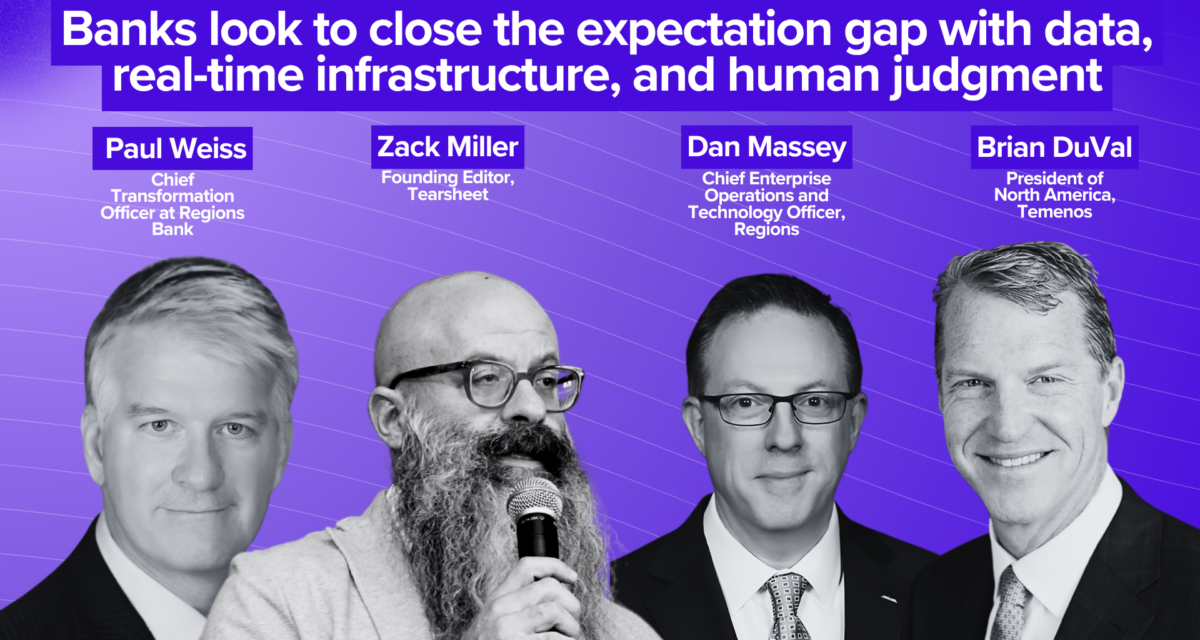
In a latest Tearsheet podcast, Massey, Weiss, and DuVal mentioned how this performs out in follow, from core platform funding and AI governance to personalization and funds.
Watch the full podcast
Listen to the full podcast
Subscribe: Apple Podcasts I SoundCloud I Spotify
Legacy knowledge turns into helpful when the basis modifications
Banks maintain a belief benefit over newer fintechs, and that very same longevity creates a technical downside. “Sometimes that data can be locked in some legacy systems, some really old technology that’s tough to get it out,” mentioned Massey. Strategic capital allocation towards platforms that may flip knowledge into one thing shoppers worth, whereas giving AI engines the inputs they want, could be the reply.
Weiss described the basis as a set of capabilities: clear knowledge, real-time interactions delivered in a cloud-native and scalable manner, and companies that may be composed into new shopper experiences. Building them is sluggish work. “Those aren’t easy to do as a series of incremental steps off of your business as usual platform,” he mentioned.
Regions’ work with Temenos on its core platforms is a part of that effort. A real-time, event-driven structure with a powerful API layer will allow a aggressive benefit, and it’s the base for the personalization the financial institution needs to provide.
AI begins in managed settings with folks in the loop
Regions started making use of generative AI in the again workplace, the place builders have seen “probably about a 30% efficiency rate,” in accordance to Massey. The financial institution has additionally deployed clever doc processing and knowledge-base brokers. It has layered generative AI onto present analytics, together with a industrial software known as RClick that assesses the well being of business shoppers, so relationship managers can question it by way of a conversational interface. The financial institution has additionally deployed agentic instruments that scan the financial institution’s setting for vulnerabilities and write code that builders can deploy rapidly.
Each use case goes by way of danger and cybersecurity assessment in parallel. “We’re very much a human-in-the-loop organization at this point,” Massey mentioned, including that the purpose is to construct patterns that may be repeated and scaled.
Weiss laid out the sequence. “You have to start with your risk and your security partners with you out of the gate,” he mentioned, adopted by a governance framework, menace modeling of every use case, and an structure with safety and danger protocols in-built. He additionally suggested staying targeted. “It’s easy to get distracted by shiny objects,” he mentioned, so enterprise-level priorities ought to decide which use circumstances get constructed.
DuVal mentioned clients have accepted the know-how however need to perceive the way it works. “Customers don’t mind if you’re using AI,” he mentioned, however they need transparency about the way it makes use of their knowledge and handles their cash. As a response, Temenos has constructed copilots for financial institution customers and a monetary crime mitigation agent, reflecting rising issues about fraud and artificial content material.
Personalization extends throughout the complete relationship
Massey mentioned many banks provide a slender set of insights drawn from transaction exercise. Regions needs a wider view. “We want to help people with their larger financial relationship versus individual products,” he mentioned. The ensuing insights could be accessible throughout digital channels and to contact middle brokers, frontline bankers, relationship managers, and wealth advisors.
According to Weiss, the business has accomplished a superb job bringing transactional capabilities into digital channels. The subsequent alternative is to add recommendation and perspective and transfer from static processes to clever workflows, which will depend on real-time capabilities and clear knowledge.
Gen AI developments additionally make it potential to serve clients as a phase of 1, in accordance to DuVal. He recounted receiving weekly mailers from competing banks providing just a few hundred {dollars} to swap accounts. The provides carry “no longer-term value that makes that sticky,” he mentioned. Banks already know quite a bit about their clients, together with the place they reside, the ages of their youngsters, and once they may be approaching school or retirement. They might use that info to ship extra related monetary planning steerage.
DuVal additionally pointed to a gap in how banks deal with shoppers. Most have premium packages for his or her top-tier clients, however he requested about “all the ones in the middle that could be their next.” Those shoppers, he mentioned, are “one of one,” and AI makes it possible to serve them that manner.
Payments mix safety and comfort
Moving cash in actual time additionally offers dangerous actors much less time to be stopped, so Regions has invested in identification verification, third-party fraud controls, and conventional and generative AI instruments for fraud prevention. It can also be rolling out passkeys for industrial, small enterprise, and shopper clients.
On the matter of comfort, Massey attracts an analogy from the delivery business. An in a single day service doesn’t ask whether or not a bundle ought to journey by boat, airplane, or truck. It asks, “Where do you want it to go? When do you need it to get there?” Banks, he mentioned, ought to do the identical and select amongst ACH, wire, and real-time fee rails on the buyer’s behalf.
For industrial shoppers, integration is a key precedence. Regions is working with fintech companions and leveraging its API layer to ship reporting and cash motion “directly into your ERP system,” so shoppers don’t want to go to a separate banking portal. The identical infrastructure additionally positions the financial institution to reply to rising demand for stablecoins and tokenized deposits.
Payments carry many expectations collectively, and the tempo of change makes structure a long-term dedication. “You’re going to have to architect for flexible, rapid, ongoing change for forever,” Weiss mentioned.
Relevance and belief form the subsequent three years
Personalized relevance, safety, and belief are rising as the expectations more than likely to reshape regional banking over the subsequent three years. Fundamental banking merchandise “can be commoditized pretty easily,” in accordance to Massey. The differentiator, he sees, is the potential to transfer cash securely and conveniently in actual time whereas providing insights tailor-made to every shopper, whether or not it’s a shopper, wealth shopper, small enterprise, or company. Massey’s purpose is to “help people live a happy life” and spare them fear about the cash facet.
DuVal framed the enterprise case when it comes to pockets share. Many banks, he mentioned, assume shoppers are staying as a result of they haven’t switched. In actuality, these clients might hold a checking account at one establishment whereas holding retirement accounts, insurance coverage, and investments elsewhere. “They’re going to have assets everywhere,” he mentioned. “If they trust the institution, they would do it there if it was easy.” A financial institution that serves as a trusted advisor, with digital instruments that complement its folks, has the likelihood to seize extra of that exercise.
“It’s easy to forget if you’re not careful that this is a human business,” mentioned Weiss. As the instruments change into extra succesful, the alternative is to assist clients succeed past facilitating a transaction on a cellphone, and getting the basis and the fundamentals proper is the path to that. “Better and easier is a good combination,” he mentioned, “and I think we’re tracking well to that.”